
Last Updated: February 11, 2026 | 18-minute read
TL;DR
AI calling scales to 10,000+ calls daily and slashes costs by 60-80 percent, but it cannot build trust the way a human can. Human calling wins on empathy, complex deal navigation, and relationship building, yet it is expensive and hard to scale. The real winner in 2026 is the hybrid model: AI qualifies and routes, humans close. This guide breaks down every angle, from hard metrics and compliance landmines to a step-by-step playbook you can implement this quarter, and shows you how to practice both sides risk-free with Tough Tongue AI.
Featured Snippet Bait
Is AI calling better than human calling for sales?
Neither is universally better. AI calling delivers 60-80 percent cost savings, 24/7 availability, and 3-5x the call volume, making it ideal for lead qualification, appointment setting, and inbound speed-to-lead. Human calling outperforms AI in trust building, complex objection handling, and enterprise deal closure. In 2026, top-performing sales organizations combine both in a hybrid workflow where AI handles initial outreach and humans handle high-value interactions.
Section 1: Why Every Sales Leader Is Asking This Question Right Now
The numbers tell the story. The AI voice agent market crossed $10.9 billion \in 2026, and 75 percent of B2B companies now use some form of AI-driven cold-calling strategy (McKinsey, 2025). Meanwhile, the average SDR \in the United States costs $75,000-$95,000 fully loaded and takes 3-6 months to ramp. AI bots? They ship in a week.
Yet scroll through any r/sales thread on Reddit and you will find fierce debate. One user captured the tension perfectly:
"I'd rather work with real AEs with real solutions... but I'd prefer to take the first call from a very good AI that won't get weird if I have a bunch of questions upfront." — Reddit, r/sales (anecdote)
That tension, between efficiency and authenticity, is exactly what this guide resolves.
What you will learn:
- A 14-point head-to-head comparison with clear winners per dimension
- Five real-world use cases with recommended approach
- TCPA and FCC compliance essentials for AI calling in 2026
- An 8-step hybrid playbook you can implement today
- How to practice AI-augmented and human-led calls using Tough Tongue AI
- Keyword research, promotion plan, and a 6-week measurement framework
Related reads on this blog:
- Best Cold Call Opening Lines from 500K+ Reddit Professionals
- The Ultimate SDR Guide: Tactics, Scripts and How to Practice
- Best Sales Training Companies in India 2026
- 3-2-1 Communication Framework: Stop Rambling
Section 2: Definitions You Need Before Comparing
What Is AI Calling?
AI calling uses voice synthesis, speech recognition, and large language models to conduct automated phone conversations. Modern platforms like Bland AI, Retell AI, Air AI, and Vapi generate human-sounding voices, follow dynamic scripts, handle objections from a library, and push structured data into your CRM, all without a human touching the phone.
What Is Human Calling?
Human calling is a trained sales rep picking up the phone, navigating a live conversation, building rapport, and making judgment calls in real time. Human reps today are typically armed with auto-dialers (Kixie, Orum), call intelligence platforms (Gong, Chorus), and CRM workflows (Salesforce, HubSpot).
What Is Hybrid Calling?
Hybrid calling layers AI on the repetitive, high-volume tasks (dialing, qualifying, scheduling) and routes engaged prospects to human reps for the high-value moments (discovery, negotiation, closing). Think of AI as the engine and humans as the steering wheel.
Section 3: The 14-Point Head-to-Head Comparison
Below is the core analysis. Each point names a winner, explains why, and gives you a concrete recommendation.
3.1 Scalability — Winner: AI
AI voice agents make 10,000+ concurrent calls across every time zone, 24 hours a day, 365 days a year. A human SDR averages 50-80 dials per day.
When to use AI: Top-of-funnel campaigns targeting 1,000+ leads per month. When to use humans: Account-based selling with fewer than 100 named targets.
3.2 Cost Efficiency — Winner: AI
AI agents cost $0.09-$0.29 per minute versus $0.42-$1.08 per minute for human agents, a 60-80 percent reduction (Gartner, 2025). No salaries, no benefits, no turnover. The catch: upfront integration can run $10K-$50K.
When to use AI: High-volume, cost-sensitive campaigns. When to use humans: High-ACV deals where cost-per-acquisition justifies premium talent.
3.3 Consistency — Winner: AI
AI follows the script perfectly every time. It never has a bad Monday, never forgets a qualifying question, and never goes off-brand. Human performance varies by mood, fatigue, and experience level.
When to use AI: Standardized qualification workflows and appointment setting. When to use humans: Situations that reward creative deviation from the script.
3.4 Emotional Intelligence — Winner: Humans
Despite advances in sentiment analysis, AI cannot genuinely empathize, detect sarcasm reliably, or mirror a prospect's emotional state. Humans read tone, pace, and silence, and they respond with authentic understanding.
"People will hang up fast if they hear a robot." — Reddit, r/sales (anecdote)
When to use AI: Low-emotion, transactional interactions. When to use humans: Relationship-driven sales, sensitive conversations, enterprise deals.
3.5 Personalization — Winner: Hybrid
AI mines LinkedIn activity, company news, job changes, and technographic data to generate personalized openers in seconds. But humans convert that data into authentic, off-script moments that build real connection. The combination is more powerful than either alone. Research shows AI-driven personalization lifts meeting rates by 36 percent (Salesloft, 2025).
Best practice: AI researches and drafts; humans add the authentic, human touch before dialing.
3.6 Speed to Lead — Winner: AI
When a prospect fills out a form, AI calls back within 5 seconds. Responding within 5 minutes rather than 30 minutes can increase conversion by 100x (InsideSales.com). Humans need notification, context, and manual dialing, often delaying response by 1-2 hours.
One Redditor confirmed:
"I have only heard of good implementations for inbound which is legal." — Reddit, r/sales (anecdote)
When to use AI: Every inbound lead follow-up, without exception.
3.7 Objection Handling — Winner: Humans
AI handles common objections ("not interested," "send me info") well. But when a prospect layers three objections, references a competitor you have never heard of, or pivots to a tangential business challenge, humans think on their feet. Creative objection handling is still a uniquely human skill.
Pro tip: Practice objection handling against AI-generated scenarios on Tough Tongue AI. The platform simulates realistic prospect pushback so your reps build confidence before they hit the phones.
3.8 Trust and Credibility — Winner: Humans
Trust closes deals. AI transparency ("I am an AI assistant calling on behalf of...") works for scheduling and qualification, but enterprise buyers making $100K+ decisions want to speak with a human who understands their business.
"If you did this from a sales team at Google... people may play along for the novelty... but it will mostly turn people off." — Reddit, r/sales (anecdote)
When to use AI: Sub-$5K transactional sales. When to use humans: Enterprise deals, strategic partnerships, C-suite conversations.
3.9 Data Capture and Analytics — Winner: AI
Every AI call generates structured data: talk time, keywords, objections raised, sentiment scores, and next-best actions, all pushed to your CRM automatically. Human reps \log \partial notes days later, if at all.
Best practice: Even when humans make the call, use AI-powered call recording tools (Gong, Chorus, Tough Tongue AI) to capture and analyze 100 percent of conversations.
3.10 Compliance — Winner: Depends on Execution
As of January 27, 2026, the FCC's one-to-one consent rule requires explicit written consent from each prospect for each specific seller before AI-generated calls can be placed for telemarketing. AI must identify itself at the call's start. Penalties reach $1,500 per violation (FCC, 2024).
"In the US and most of Europe it's illegal to call with AI without consent." — Reddit, r/sales (anecdote)
Key rules:
- AI voices are classified as "artificial or prerecorded voices" under TCPA
- Prior express written consent is required for telemarketing AI calls
- AI must disclose its nature at the start of every call
- Consumers can revoke consent through "any reasonable means"
Recommendation: Use AI calling only for opted-in lists and inbound follow-up. Use human calling for outbound cold outreach where consent status is unclear. Always consult legal counsel.
3.11 Training and Ramp Time — Winner: AI
AI deploys in days. Human SDRs take 3-6 months to ramp to full productivity. But here is the twist: if you use Tough Tongue AI for rep training, you can cut human ramp time by practicing calls against AI-simulated prospects before going live. Reps build muscle memory on objection handling, discovery questions, and closing techniques in a safe environment.
3.12 Handling Complexity — Winner: Humans
Multi-stakeholder deals, custom pricing, technical requirements, procurement processes: humans navigate these with strategic thinking that AI cannot replicate. AI falters when conversations go off-script or require cross-referencing multiple data points in real time.
When to use AI: Simple, transactional sales under $5K ACV. When to use humans: Complex enterprise deals above $25K ACV.
3.13 Brand Perception — Winner: Context-Dependent
A tech startup using AI calling signals innovation. A wealth management firm using AI calling signals "you are not important enough for a real person." Know your audience.
"Seen as impersonal and might imply business lacks staff/skills." — Reddit, r/sales (anecdote)
3.14 Continuous Improvement — Winner: AI (with Human Input)
AI analyzes 10,000 calls overnight to identify which openers, talk times, and objection responses correlate with meetings booked. Humans learn through coaching and repetition, a slower but more intuitive loop. The best teams feed AI insights back into human coaching, use Tough Tongue AI to drill the patterns that data reveals work, and close the feedback loop weekly.
Section 4: The Comparison Scoreboard
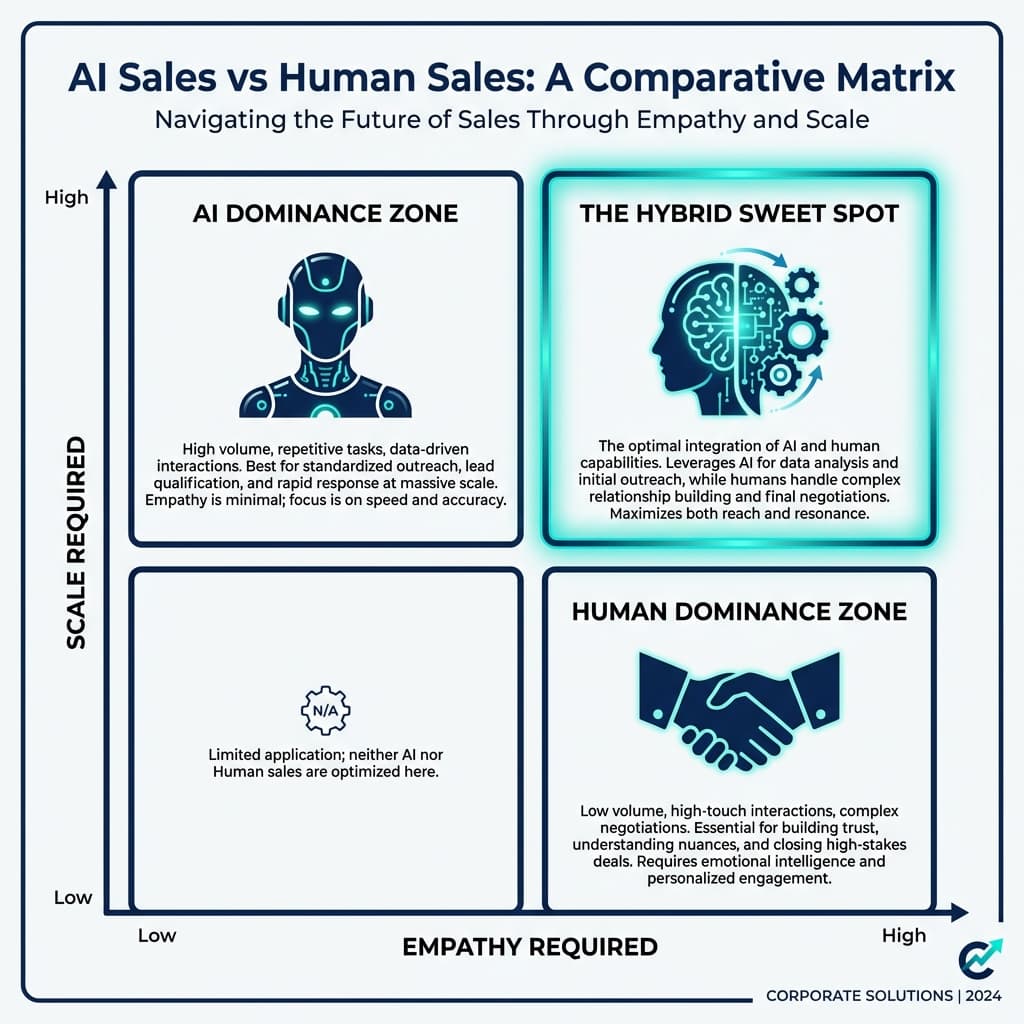
| Dimension | AI Calling | Human Calling | Best Approach |
|---|---|---|---|
| Scalability | 10,000+ calls/day | 50-80 calls/day | AI for volume |
| Cost | $0.09-$0.29/min | $0.42-$1.08/min | AI for cost savings |
| Consistency | 100% script adherence | Variable | AI for standardization |
| Emotional Intelligence | Basic sentiment only | Deep empathy | Humans for relationships |
| Personalization | Data-driven research | Authentic connection | Hybrid |
| Speed to Lead | Under 5 seconds | 1-2 hours average | AI for inbound |
| Objection Handling | Scripted responses | Creative problem-solving | Humans for complex objections |
| Trust | Transparent but limited | Deep relationship | Humans for enterprise |
| Data Capture | 100% automated | Partial, manual | AI or AI-augmented |
| Compliance | Automated but strict rules | More flexible | Depends on jurisdiction |
| Ramp Time | Days | 3-6 months | AI (or Tough Tongue AI to accelerate humans) |
| Complexity | Simple transactions | Multi-stakeholder deals | Humans for enterprise |
| Brand Perception | Innovation signal | Premium signal | Context-dependent |
| Improvement Speed | Learns from thousands | Learns from coaching | Hybrid feedback loop |
Bottom line: AI wins 6 categories, humans win 5, and hybrid wins 3. This is not a replacement story. It is a collaboration story.
Section 5: Five Use Cases with Clear Recommendations
Use Case 1: B2B SDR Outbound at Scale
Scenario: SaaS company, 5,000 mid-market prospects per month, goal of 100 demos.
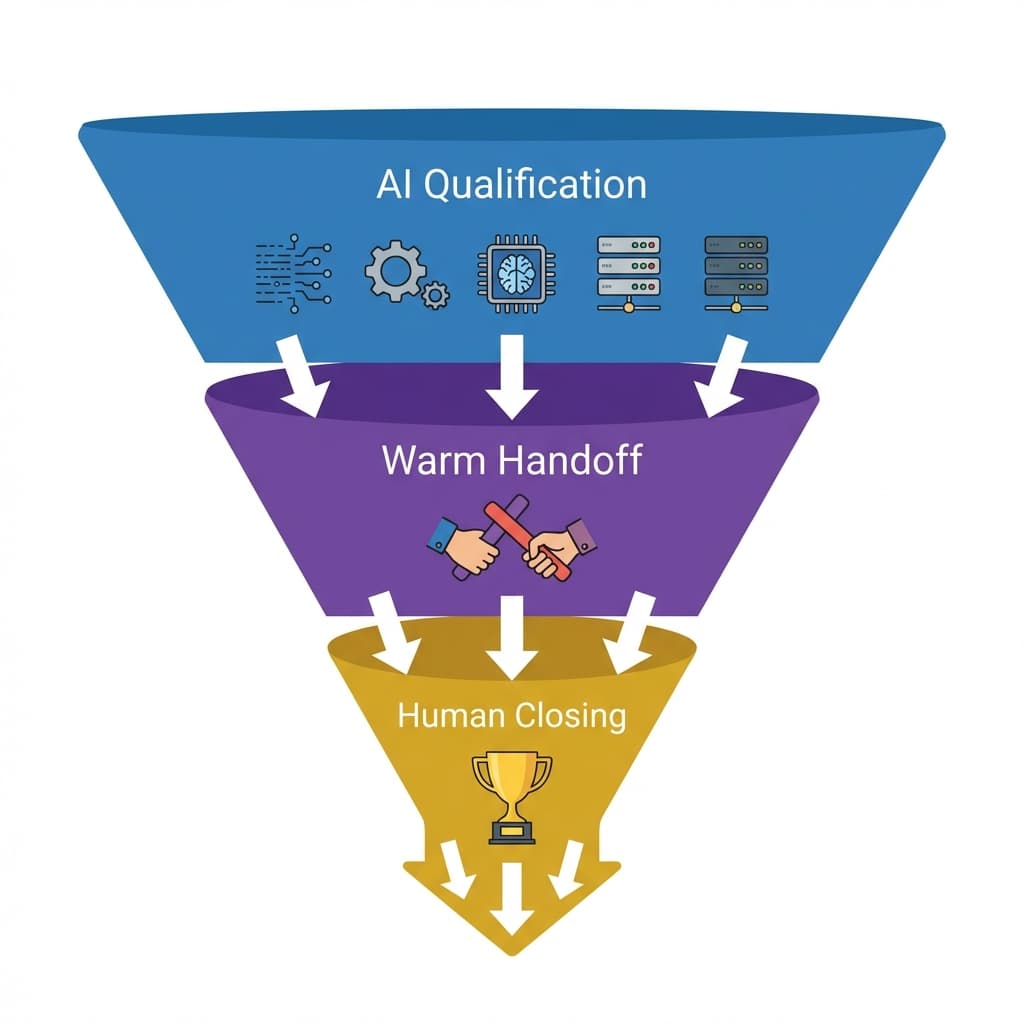
Recommended approach: Hybrid. AI dials 5,000 prospects, identifies live answers, qualifies on budget and authority, then transfers engaged prospects to human SDRs who build rapport and book demos.
Expected results: 3-5x call volume, 40 percent lower cost per meeting, higher show rates because the prospect spoke with a real human.
Use Case 2: Inbound Lead Response
Scenario: 500 inbound leads per month from website forms.
Recommended approach: AI calling. AI responds within 60 seconds, qualifies using BANT, and books meetings directly or routes to a human for complex inquiries.
Expected results: 100 percent contact rate (versus 40 percent with human follow-up), 60 percent increase in SQLs, zero leads lost to competitor speed.
Use Case 3: Appointment Setting for Field Sales
Scenario: Medical device company scheduling in-person demos with hospital administrators.
Recommended approach: AI with human confirmation. AI schedules; a human rep confirms 24 hours before.
Expected results: 4x more appointments booked, 75 percent show rate, 80 percent cost reduction.
Use Case 4: Collections and Payment Reminders
Scenario: Subscription business, 2,000 overdue accounts per month.
Recommended approach: AI calling. Friendly, consistent tone. Self-service payment links. Escalation to humans only for disputes.
Expected results: 65 percent resolved without human intervention, 90 percent cost reduction, improved customer satisfaction.
Use Case 5: Enterprise Deal Closing
Scenario: Selling a $250K annual platform to a Fortune 500 company with 7 stakeholders.
Recommended approach: Human calling only. No AI. The stakes are too high for anything less than a seasoned AE who can navigate politics, build champion relationships, and orchestrate a complex sales cycle from discovery through procurement. Use Tough Tongue AI to rehearse the discovery call, the executive presentation, and the negotiation before going live.
Section 6: The Hybrid Playbook — 8 Steps to Combine AI and Human Calling
Step 1: Define Handoff Triggers
Set clear rules for when AI transfers to a human:
- Prospect asks a technical question the AI cannot answer
- Deal size exceeds your threshold (for example, $10K ACV)
- Prospect mentions a competitor by name
- Sentiment analysis detects frustration or high interest
- Prospect explicitly asks for a human
Step 2: AI Opens with Transparency
Script your AI opener for FCC compliance and trust:
"Hi, this is Alex, an AI assistant calling from [Company]. I want to be upfront that I'm an AI. We help companies like [Peer Company] solve [Pain Point]. Can I take 30 seconds to share why I'm reaching out?"
Step 3: AI Qualifies Using BANT
AI asks structured questions on Budget, Authority, Need, and Timeline. Responses are scored automatically and pushed to CRM.
Step 4: Warm Handoff with Context
When the AI transfers, the human rep receives a real-time briefing: prospect name, company, qualification scores, objections raised, and conversation summary. No cold transfer. No "can you repeat that?"
Step 5: Human Closes
The human rep picks up with context:
"Hi [Name], [Human Name] here from [Company]. I saw you just spoke with Alex about [specific pain point]. I've worked with [similar company] on exactly that. Let me show you what we did."
Step 6: AI Handles Post-Call Admin
After the human closes (or nurtures), AI logs the call, updates the CRM, sends follow-up emails, and schedules next steps. Human reps never touch a CRM field.
Step 7: Analyze and Iterate Weekly
Run weekly call analytics comparing AI and human performance:
- Connect rates, conversion rates, average talk time
- Handoff success rate (percentage of transfers that result in meetings)
- Customer satisfaction scores
Step 8: Train Humans on AI Insights
The patterns that AI identifies from thousands of calls, like which openers work, which objections stall deals, and which talk-to-listen ratios correlate with closed deals, should feed directly into human coaching. Use Tough Tongue AI's practice collections to drill these patterns in simulated calls before reps go live.
Section 7: Case Study — How a Mid-Market SaaS Team Went Hybrid
Company profile: B2B SaaS, $15M ARR, 12-person sales team, selling $20K-$80K ACV deals.
Before hybrid (human-only):
- 800 outbound calls per week across 8 SDRs
- 12 percent connect rate
- 15 meetings booked per week
- $420 cost per meeting
- 3.5 month average SDR ramp time
After hybrid (AI + human):
- 4,000 outbound calls per week (AI handles first touch)
- 11 percent connect rate (slight drop due to AI detection)
- 38 meetings booked per week (153 percent increase)
- $165 cost per meeting (61 percent reduction)
- SDR ramp time cut to 6 weeks using Tough Tongue AI for practice
What changed:
- AI made all first-touch calls and handled qualification
- Human SDRs only spoke with pre-qualified, engaged prospects
- SDRs spent 80 percent of their time in conversations, not dialing
- New SDRs practiced 50+ call simulations on Tough Tongue AI before their first live call
- Weekly coaching sessions used AI call analytics to identify improvement areas
Key insight: The team did not reduce headcount. They redeployed SDRs from dialing to closing, and every rep's quota went up.
Section 8: Compliance Essentials for AI Calling in 2026
This section is for informational purposes only. It is not legal advice. Always consult qualified legal counsel for compliance decisions.
United States: TCPA and FCC Rules
- AI voices = robocalls. The FCC classified AI-generated voices as "artificial or prerecorded voices" in February 2024.
- One-to-one consent rule (January 27, 2026). Each seller needs individual written consent. No more shared consent through lead aggregators.
- Disclosure required. AI must identify itself at the beginning of every call.
- Revocation. Consumers can revoke consent through "any reasonable means," including simply saying "stop."
- Penalties. Up to $1,500 per violation, and the FCC is increasing enforcement resources.
European Union: ePrivacy and GDPR
- Consent requirements are broadly similar, with GDPR adding data processing obligations.
- Legitimate interest rarely covers unsolicited AI calls.
- Right to explanation under GDPR may require disclosing how AI made the decision to call.
Practical Compliance Checklist
- Obtain individual written consent before AI telemarketing calls
- Disclose AI use at the call's start
- Offer easy opt-out on every call
- Maintain auditable consent records
- Honor "stop" requests across all channels
- Review DNC (Do Not Call) registry compliance
- Consult legal counsel quarterly on regulatory changes
Section 9: Practice Both Sides Risk-Free with Tough Tongue AI
Whether your team uses AI calling, human calling, or a hybrid model, one thing does not change: your human reps need to be sharp. Even in a hybrid workflow, the human is the closer. Their ability to handle objections, build rapport in seconds, and navigate complex conversations determines revenue.
Tough Tongue AI is the practice layer that makes this happen. Here is how it fits into the AI-vs-human calling conversation:
For Teams Using AI Calling
- Practice handoff conversations. When AI transfers a qualified prospect, your rep has 10 seconds to establish credibility. Tough Tongue AI simulates those exact moments so reps nail the warm handoff every time.
- Train on objection patterns. AI call analytics reveal your top 10 objections. Build custom practice scenarios in Tough Tongue AI that drill those specific objections until responses are automatic.
For Teams Using Human Calling
- Reduce ramp time. New SDRs practice 50+ simulated cold calls, discovery calls, and objection-handling scenarios before making their first live call. The case study above cut ramp time from 3.5 months to 6 weeks.
- Build confidence. Rejection anxiety is the number-one reason SDRs quit. Practicing against AI removes the fear by building muscle memory in a zero-risk environment.
For Hybrid Teams
- Simulate the full workflow. Practice the AI-to-human handoff, the context-loaded opener, the qualification confirmation, and the close, all in one simulated call.
- Weekly coaching drill. Use AI-identified patterns from real calls to create targeted practice sessions. If data shows reps struggle with the "we already have a vendor" objection, build a Tough Tongue AI scenario that drills exactly that.
Start practicing today: Explore Tough Tongue AI practice collections
Section 10: Data and Metrics for Measuring Performance
Core KPI Comparison Table
| Metric | AI Calling | Human Calling | Hybrid |
|---|---|---|---|
| Calls per day | 10,000+ | 50-80 | 500-1,000 |
| Connect rate | 8-12% | 5-10% | 10-15% |
| Conversion to meeting | 2-4% | 3-6% | 5-8% |
| Cost per lead | $15-$30 | $50-$100 | $25-$50 |
| Average talk time | 2-4 min | 5-10 min | 3-6 min |
| Meeting show rate | 45-55% | 60-70% | 65-75% |
| NPS (post-call) | 6-7/10 | 7-9/10 | 7-8/10 |
| Spam flag rate | 15-25% | 5-10% | 8-12% |
Note: Benchmarks are compiled from industry reports and community discussions. Your results will vary. Always validate with controlled A/B tests.
What to Track in Your 6-Week Test
| Week | Focus | Key Metric |
|---|---|---|
| 1-2 | Baseline human-only performance | Connect rate, meetings/week |
| 3-4 | Introduce AI for first-touch qualification | Handoff rate, meeting quality |
| 5-6 | Full hybrid workflow | Cost per meeting, pipeline value, rep satisfaction |
Frequently Asked Questions
Arguments for and against AI calling are complex. Here are the answers to the most common questions sales leaders ask.
Is AI calling legal in the United States?
AI calling is legal but heavily regulated. The FCC classified AI-generated voices as robocalls in 2024. For telemarketing, you need prior express written consent from each individual prospect for each specific seller. AI must identify itself at the start of every call. Violations carry penalties up to $1,500 per call. Always consult legal counsel before deploying AI calling.
How much does AI calling cost compared to human calling?
AI calling typically costs $0.09-$0.29 per minute, while human calling costs $0.42-$1.08 per minute. This translates to 60-80 percent cost savings. However, AI calling requires upfront investment in platform setup ($10K-$50K) and ongoing maintenance. For most mid-market companies, the break-even point is reached within 2-3 months.
Can AI calling replace human sales reps?
AI calling cannot fully replace human sales reps in 2026. AI excels at high-volume, repetitive tasks like lead qualification and appointment setting, but it cannot replicate human empathy, creative objection handling, or complex deal navigation. The most effective teams use AI to augment human reps, not replace them. Human reps focus on high-value conversations while AI handles the dialing and qualifying.
What is the best hybrid AI-human calling workflow?
The best hybrid workflow follows this sequence: (1) AI makes the initial outbound call and qualifies the prospect using BANT criteria, (2) AI transfers qualified prospects to human reps with full context, (3) human reps conduct discovery, build rapport, and close, (4) AI handles post-call admin including CRM updates and follow-up scheduling. This approach typically delivers 3-5x more meetings at 40-60 percent lower cost.
How do I train my sales reps to work alongside AI calling systems?
Train reps to master the "warm handoff" moment, where they meet a pre-qualified prospect mid-conversation. Practice with Tough Tongue AI simulations that replicate the exact handoff scenario. Focus on: (1) quickly establishing human credibility, (2) confirming qualification without re-asking questions, (3) transitioning smoothly into discovery. Teams using simulation-based training cut ramp time by 50 percent or more.
What metrics should I track when comparing AI and human calling?
Track these core metrics for a fair comparison: connect rate, conversion to meeting, cost per lead, average talk time, meeting show rate, and post-call NPS score. Also monitor compliance metrics like spam flag rate and consent verification rate. Run a minimum 6-week A/B test with equal lead quality for both channels before drawing conclusions.
Conclusion: The Future Is Not AI or Human. It Is AI and Human.
The AI-vs-human calling debate is a false binary. The data is clear: AI handles volume and efficiency; humans handle trust and complexity. The teams winning in 2026 are not choosing one over the other. They are building hybrid workflows where AI does the heavy lifting and humans do the heavy thinking.
Your action plan:
- Audit your current calling workflow — identify where AI can add volume without sacrificing quality
- Run a controlled test — split your leads and test the hybrid model against your current baseline
- Invest in human skill development — use Tough Tongue AI to practice objection handling, discovery calls, and warm handoffs so your reps are ready when AI delivers the qualified lead
- Stay compliant — review Section 8 and consult legal counsel before deploying any AI calling
- Measure relentlessly — track the KPIs in Section 10 and iterate weekly
The phone is not dead. It is evolving. Make sure your team evolves with it.
Ready to sharpen your team's calling skills? Start practicing with Tough Tongue AI
Disclaimer: This article is for informational purposes only and does not constitute legal advice. AI calling regulations vary by jurisdiction and change frequently. Always consult qualified legal counsel before implementing AI calling in your sales workflow. Statistics cited from Reddit are marked as anecdotal and should be validated through your own testing.
External Sources: