
Reading time: 18 minutes | Last updated: January 29, 2026
Executive Summary: The Answer for Decision Makers
Yes, AI is automating 60–80% of traditional SDR operational tasks including research, lead scoring, email personalization, follow-ups, and basic demos. No, SDRs are NOT becoming obsolete. Instead, SDRs are evolving into relationship-driven revenue professionals working alongside AI.
AI will own: prospect research, qualification automation, demo delivery, and operational follow-ups. Humans will own: trust building, complex objection handling, strategic negotiations, and relationship depth across buying committees.
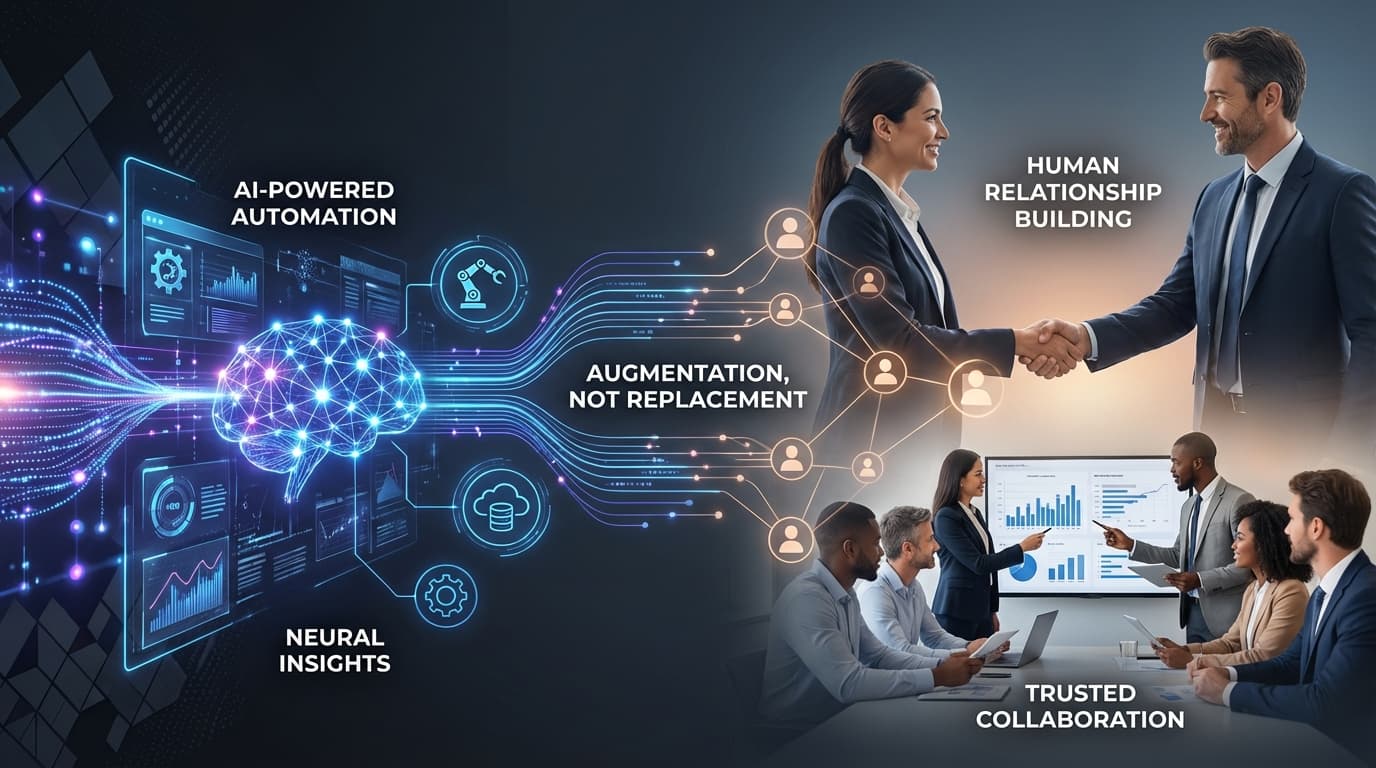
The future of sales development is hybrid SDR + AI. Organizations deploying this model see faster sales cycles, higher conversion rates, and more strategic SDR contributions. SDRs who refuse to evolve will be replaced by SDRs who master AI augmentation.
Bottom line for sales leaders: Don't replace SDRs with AI. Empower SDRs with AI and retrain them as Relationship Architects.
The Reality: What AI Has Already Replaced in SDR Work
Let's be direct: AI has already automated the majority of operational SDR work. According to revenue operations data from enterprise SaaS companies, AI now handles 60–80% of traditional SDR tasks.
What AI Automates Today
Prospect Research & Enrichment
AI tools like Apollo, Clay, and 6sense scrape LinkedIn, company websites, news, and intent data to build comprehensive prospect profiles in seconds—work that previously took SDRs 15-30 minutes per prospect.
Lead Scoring & Prioritization
Machine learning models analyze 50+ signals (firmographics, technographics, behavioral intent, engagement history) to score and prioritize leads more accurately than human intuition ever could.
Cold Email Personalization at Scale
AI writes personalized cold emails pulling from prospect data, company news, and proven templates. Tools like Lavender, Copy.ai, and Regie.ai generate hundreds of customized emails daily.
Automated Follow-Up Sequences
AI-powered sequences track opens, clicks, and engagement to trigger perfectly timed follow-ups across email, LinkedIn, and phone—eliminating the manual tracking SDRs once managed in spreadsheets.
Meeting Scheduling & Calendar Management
Chili Piper, Calendly, and built-in AI schedulers eliminate the 5-8 email back-and-forth to book meetings. One-click instant booking replaces SDR coordination.
First-Touch Qualification
Conversational AI chatbots (Drift, Intercom, Qualified) handle initial qualification questions, collect contact information, and route high-intent prospects to SDRs based on BANT criteria.
Basic Product Walkthroughs
AI demo platforms deliver personalized product tours 24/7 without SDR involvement. Buyers educate themselves asynchronously before human contact.
Demo Scheduling + Automated Demos
Platforms like Tough Tongue AI enable intelligent, scenario-based demos where buyers interact with AI to explore product capabilities, ask questions, and see customized use cases—completely automated.
CRM Data Entry & Activity Logging
AI automatically logs calls, emails, meeting notes, and next steps directly into Salesforce, HubSpot, or other CRMs using tools like Gong, Chorus, and Grain.
The Market Shift: From Manual to Automated
A 2025 study by Pavilion (the leading B2B SaaS sales community with 10,000+ revenue leaders) found:
- 72% of B2B sales orgs have deployed AI for outbound prospecting
- 67% use AI for lead scoring and prioritization
- 54% have implemented AI-powered email tools
- 43% use conversational AI for first-touch qualification
The automation wave isn't coming—it's here. The question isn't whether AI will replace SDR tasks. The question is: What's \left for humans to own?
Why Full Replacement of SDRs Is a Myth
Despite AI's operational dominance, the idea that SDRs will be fully replaced is fundamentally flawed. Here's why B2B buying psychology, enterprise complexity, and human trust dynamics make full AI replacement impossible.
B2B Buying Is Emotional + Political, Not Purely Rational
Enterprise deals involve 6–10 stakeholders with competing priorities, political agendas, and personal risk. A CFO cares about ROI; a VP of Engineering cares about technical fit; an end-user cares about usability. Navigating these political crosscurrents requires human judgment, empathy, and relationship intuition that AI cannot replicate.
Forrester research shows that emotional and psychological factors drive 50% of B2B purchase decisions—not just features and pricing. Buyers ask themselves:
- "Do I trust this company to support us post-sale?"
- "Will this vendor be a strategic partner or transactional supplier?"
- "Can I bet my career on this decision?"
AI cannot build the credibility required to answer "yes" to these questions in high-stakes, high-ACV deals.
Enterprise Deals Require Trust Built Over Months
Complex sales cycles in enterprise B2B SaaS average 6-18 months. During this time, champions leave, budgets shift, priorities change, and new stakeholders enter. Relationship continuity and trust compounding over months require human memory, empathy, and strategic adaptation.
An AI cannot:
- Remember a conversation from 4 months ago where a champion expressed personal career concerns
- Adapt messaging when a new CISO joins mid-cycle with different security priorities
- Navigate a budget freeze by proposing creative contract structures
- Build the deep personal rapport that keeps deals alive through organizational turbulence
Multi-Stakeholder Alignment Needs Human Orchestration
Selling to a buying committee of 8 people requires orchestrating consensus across conflicting interests:
- Economic Buyer (CFO) wants financial justification
- Technical Buyer (CTO) wants integration feasibility
- User Buyer (Director of Sales) wants ease of use
- Coach/Champion wants political air cover to advocate internally
AI cannot read the room, sense tension between stakeholders, or craft the narrative that aligns disparate agendas. This is human art, not algorithmic science.
Objection Handling Requires Contextual Empathy
True objection handling goes beyond scripted responses. It requires:
- Reading between the lines: "We're happy with our current solution" often means "I'm risk-averse and need more proof."
- Addressing unspoken concerns: Budget objections frequently mask political power struggles.
- Adaptive storytelling: Shifting case studies based on prospect's emotional state and energy.
AI can provide scripted rebuttals. Humans provide contextual, empathetic problem-solving that turns skeptics into champions.
Regulated Industries Demand Human Accountability
In healthcare, financial services, and government sectors, compliance and accountability requirements mandate human oversight. A hospital CIO buying a patient data platform cannot rely on AI alone to guarantee HIPAA compliance, security protocols, and vendor accountability.
Legal and reputational risk in regulated industries requires human judgment, strategic thinking, and accountability that AI cannot provide.
Complex Negotiations Need Strategic Flexibility
Late-stage negotiations involve:
- Multi-year contract structures
- Custom pricing tiers
- Integration roadmaps
- Service level agreements (SLAs)
- Security audits and legal review
These discussions require strategic flexibility, creative problem-solving, and real-time adaptation based on subtle verbal and non-verbal cues. AI excels at pattern matching, not strategic improvisation.
The New SDR Role: From Dialer to Relationship Architect
The SDR role isn't disappearing—it's evolving upmarket and becoming more strategic. The modern SDR of 2026 and beyond is a Relationship Architect: someone who builds trust, navigates buying committees, and acts as a strategic revenue partner.
The Relationship Architect: Core Competencies
1. Trust Builder
In a world of AI-generated outreach, human credibility is the scarcest resource. SDRs become the face of authentic relationship building—the person buyers know, trust, and turn to when stakes are high.
2. Account-Based Selling Partner
Instead of volume-based outbound, SDRs focus on fewer, higher-value accounts with strategic account plans, multi-threaded relationship mapping, and coordinated campaigns across marketing, sales, and customer success.
3. Buying Committee Navigator
SDRs master the art of multi-stakeholder engagement: identifying champions, mapping influence networks, orchestrating consensus, and aligning messaging across economic, technical, and user buyers.
4. Strategic Conversation Owner
SDRs don't pitch features—they facilitate business conversations. They ask strategic discovery questions, uncover business pain, quantify ROI, and position solutions as strategic enablers, not point tools.
5. Value Consultant
Modern SDRs bring industry expertise, competitive insights, and best-practice knowledge to every conversation. They act as trusted advisors who educate buyers, not just vendors pushing products.
6. Objection Handler & Deal Advocate
When deals stall, SDRs leverage relationship depth to diagnose real blockers, address political concerns, and advocate internally for creative solutions (pricing, contract terms, implementation timelines).
From Volume to Value: The Strategic Shift
| Old SDR Model (Pre-AI) | New SDR Model (Hybrid AI Era) |
|---|---|
| 80 dials/day targeting volume | 10 strategic accounts with deep research |
| Generic pitch scripts | Consultative discovery conversations |
| Cold outreach to anyone | Warm intros via champions + AI demos |
| Feature education | Business outcome alignment |
| Transactional booking of meetings | Strategic relationship development |
| Individual performance metrics | Team-based revenue contribution |
| Measured on activity (calls/emails) | Measured on pipeline quality + velocity |
The future SDR is moving upmarket. They're not doing less work—they're doing higher-leverage, more strategic work that AI cannot replicate.
The Winning Model: AI + SDR Working Hand in Hand
The highest-performing sales organizations don't choose between AI and humans. They deploy a clear division of labor where AI owns operational efficiency and humans own strategic relationship value.
The Hybrid Responsibility Framework
| Function | AI Ownership | Human SDR Ownership |
|---|---|---|
| Research | Prospect enrichment, intent data aggregation | Strategic account prioritization, insight synthesis |
| Lead Scoring | Algorithmic scoring based on 50+ signals | Human judgment for strategic fit + timing |
| Outreach | Automated email sequences, A/B testing | Personal video messages, warm introductions |
| Demo | 24/7 AI-powered product walkthroughs | Relationship follow-up, strategic conversations |
| Qualification | BANT collection, initial fit assessment | Deep discovery, strategic validation |
| Objections | Surface-level FAQ responses | Nuanced objection handling, empathetic persuasion |
| Trust Building | — | Relationship continuity, credibility establishment |
| Closing Influence | — | Stakeholder alignment, negotiation, advocacy |
How It Works in Practice
Stage 1: AI-Led Prospecting
AI tools identify high-intent accounts, enrich data, score leads, and trigger automated outreach sequences. SDRs receive a prioritized list of warm prospects who have already engaged with content, visited pricing pages, or requested demos.
Stage 2: AI-Powered Demos
Instead of SDRs spending 45 minutes on generic product walkthroughs, platforms like Tough Tongue AI deliver intelligent, scenario-based demos where buyers interact with AI to explore use cases, ask questions, and see personalized value. Buyers self-educate asynchronously.
Stage 3: Human Relationship Building
SDRs receive notifications when a prospect completes an AI demo and is ready for human engagement. Now, instead of "walking through features," SDRs have strategic conversations about business outcomes, ROI, implementation, and buying process—because the buyer is already educated.
Stage 4: Hybrid Qualification + Advancement
AI qualifies basic fit (industry, company size, budget range, timeline). SDRs validate strategic fit: Is this the \right time? Who are the stakeholders? What's the political landscape? What's driving urgency?
Stage 5: Human-Led Closing
As deals progress, SDRs hand off to Account Executives but remain involved as relationship anchors—attending key meetings, addressing objections, and ensuring continuity through the sales cycle.
The Result: Better Outcomes for Everyone
For Buyers:
- Self-serve education on their timeline
- No pressure demos available 24/7
- Higher-quality human conversations when needed
- Faster answers to strategic questions
For SDRs:
- More time on high-value relationship building
- Warmer, more educated prospects
- Clearer path to revenue contribution
- Skills development in strategic selling
For Sales Leaders:
- Higher pipeline quality and velocity
- Scalable demo delivery without headcount
- More accurate forecasting with AI data
- SDR team evolving into strategic revenue drivers
Why Demos Will Be AI-First (And Why That's Good)
The demo is the most significant unlock in the hybrid AI + SDR model. Here's why AI-first demos are not just inevitable but strategically superior.
The Async Buying Revolution
Modern B2B buyers don't want to book a 30-minute demo with a sales rep to answer basic questions. 67% of buyers prefer self-serve resources over talking to sales (Gartner, 2025).
Buyers want:
- Instant access without calendar coordination
- Self-paced exploration on their schedule
- Zero pressure to make premature decisions
- Personalized experiences tailored to their use case
- Repeatability to share with stakeholders internally
AI-powered demos deliver all of this. Platforms like Tough Tongue AI enable buyers to interact with intelligent product simulations, ask questions, and explore scenarios 24/7—without a single SDR involved.
The Problem with Human-Only Demos
Traditional SDR-led demos have inherent limitations:
- Calendar dependency: 3-5 days to schedule = lost momentum
- Inconsistent messaging: 10 SDRs = 10 different demos
- Rep availability: Limited to business hours in specific time zones
- Pressure dynamics: Buyers feel rushed to ask "smart questions"
- Scaling constraints: More demos = more headcount
AI solves all of these problems.
What Makes AI Demos Superior
1. 24/7 Availability
A CTO in Singapore can explore your product at 2 AM local time without waiting for a US-based SDR's calendar.
2. Consistent Messaging
Every prospect gets the same high-quality, on-brand experience aligned with your value proposition.
3. Personalized Pathways
AI adapts demos based on industry, role, and use case. A CFO sees ROI dashboards; a product manager sees workflow automation.
4. Zero Scheduling Friction
No back-and-forth emails. No calendar conflicts. Instant access = higher conversion.
5. Buyer Enablement
Buyers can replay demos, share with teammates, and revisit specific sections—empowering internal champions to advocate effectively.
6. Data-Rich Insights for SDRs
AI tracks which features prospects explored, how long they engaged, which questions they asked, and where they dropped off. SDRs receive actionable intel for follow-up conversations.
The SDR's New Role: Demo Follow-Up, Not Demo Delivery
When AI handles the demo, SDRs shift from educators to consultants.
Instead of asking, "Let me show you how this works," SDRs ask:
- "I saw you explored our workflow automation feature—what process are you trying to optimize?"
- "You spent time on our ROI calculator—what metrics are most important to your CFO?"
- "Which use case resonated most with your team?"
This is strategic selling, not feature pitching.
Tough Tongue AI: The Hybrid Sales Engine
This is where the future of sales development is already being built. Tough Tongue AI is the platform enabling the hybrid AI + SDR model at scale.
The Three-Layer Sales Engine
Layer 1: AI Demo Layer
Tough Tongue AI delivers intelligent, scenario-based product demos where prospects interact with AI to explore features, ask questions, and see personalized use cases. Buyers self-educate 24/7 without SDR involvement.
Layer 2: Sales Enablement Layer
SDRs receive real-time notifications when prospects complete demos, along with engagement analytics: which features they explored, how long they engaged, and which questions they asked. SDRs approach conversations armed with context.
Layer 3: Human Relationship Layer
SDRs focus entirely on relationship building, strategic discovery, objection handling, and deal advancement—because AI has already handled education.
How Tough Tongue AI Works
For Buyers:
- Click a "Try Interactive Demo" link on your website
- Interact with AI to explore product scenarios tailored to their role
- Ask questions, see custom use cases, and explore at their pace
- Receive instant answers without sales pressure
- Share the experience with teammates for internal alignment
For SDRs:
- Receive notifications when high-intent prospects complete demos
- View engagement analytics: time spent, features explored, questions asked
- Approach follow-up conversations with strategic context
- Focus on relationship building instead of feature walkthroughs
- Convert warmer, more educated prospects at higher rates
For Sales Leaders:
- Deploy AI demos across unlimited prospects without headcount scaling
- Maintain consistent messaging and brand quality
- Track demo engagement as a leading indicator of pipeline quality
- Reallocate SDR capacity from demos to relationship selling
- Measure ROI: demo-to-qualified-meeting rate, pipeline velocity, conversion lift
The Tough Tongue AI Advantage
No-Code Scenario Creation
Sales enablement teams build custom demo scenarios using natural language prompts—no developers required.
Multimodal AI Interactions
AI doesn't just answer text questions. It generates images, creates diagrams, walks through slides, and uses interactive tools to simulate real product experiences.
API + Iframe Embed
Deploy Tough Tongue AI demos on your website, in email campaigns, or via API in 4 lines of code. Works seamlessly with your existing stack.
Long-Term Memory
AI remembers prospect interactions across sessions, personalizing follow-up experiences and ensuring continuity—just like a human SDR would.
Real Results: What Teams Are Seeing
Organizations deploying Tough Tongue AI report:
- 80% reduction in SDR time spent on generic demos
- 7x increase in demo volume without headcount growth
- Higher pipeline quality from demo-educated prospects
- Shorter sales cycles due to educated buyers reaching SDRs ready for strategic conversations
- Improved SDR satisfaction from focusing on high-value relationship work
💼 Ready to Transform Your Sales Development?
See how Tough Tongue AI enables your team to automate demos while SDRs focus on relationships and revenue.
Start Free Trial →
One sales leader at a Series B SaaS company put it this way:
"Tough Tongue AI gave us the best of both worlds. Our buyers get instant, personalized demos 24/7. Our SDRs spend zero time on generic walkthroughs and 100% of their time building relationships with educated, qualified prospects. Pipeline quality and velocity both improved dramatically."
That's the hybrid model in action.
What Sales Leaders Should Do Now
If you're a CRO, VP of Sales, or sales leader, here's your 5-step actionable playbook to successfully integrate AI into sales development without displacing your SDR team.
Step 1: Audit Your SDR Task Breakdown
Action: Conduct a time-motion study of how SDRs actually spend their time.
How:
- Shadow 5-10 SDRs for a full week
- Track time spent on: research, outreach, follow-up, demos, qualification calls, administrative tasks, relationship building
- Calculate percentage of time on low-value operational tasks vs. high-value strategic activities
What to measure:
- % of time on manual research (likely 20-30%)
- % of time on generic demos (likely 25-35%)
- % of time on data entry and CRM hygiene (likely 10-15%)
- % of time on strategic relationship conversations (likely only 15-25%)
Goal: Identify where AI can free up 40-50% of SDR capacity for reallocation to relationship selling.
Step 2: Automate Low-Value SDR Tasks
Action: Deploy AI tools to eliminate operational busywork.
Specific tools to implement:
| Task | AI Tool | Expected Time Savings |
|---|---|---|
| Prospect research | Apollo, Clay, 6sense | 60-80% |
| Lead scoring | Native CRM AI, Madkudu | 70-90% |
| Email personalization | Lavender, Copy.ai, Regie.ai | 50-70% |
| Follow-up sequences | Outreach, Salesloft, HubSpot | 80-90% |
| Meeting scheduling | Chili Piper, Calendly | 90%+ |
Implementation timeline: 4-8 weeks for full deployment
Success metric: Measure hours saved per SDR per week. Target: 15-20 hours reclaimed.
Step 3: Deploy AI Demo Platform
Action: Implement Tough Tongue AI or similar AI demo platform for 24/7 buyer enablement.
How:
- Build 3-5 core demo scenarios aligned with your ICP use cases
- Embed demos on high-traffic website pages (pricing, product pages, case studies)
- Include demo links in all outbound email campaigns
- Track engagement analytics: completion rate, time spent, feature exploration
Expected outcomes:
- 5-10x more demos delivered per month (no SDR capacity constraint)
- 30-50% of prospects self-educate before SDR contact
- SDRs receive warmer, more qualified pipeline
- Shorter sales cycles from educated buyers
Integration: Works with Salesforce, HubSpot, and all major CRMs via API or native integrations.
Step 4: Retrain SDRs on Relationship Selling
Action: Shift SDR training from operational efficiency to strategic relationship skills.
New training curriculum:
Module 1: Consultative Discovery
- Asking strategic questions instead of pitching features
- Uncovering business pain, not just technical requirements
- Quantifying ROI and business impact
Module 2: Objection Handling
- Handling complex objections beyond scripted rebuttals
- Reading emotional subtext in buyer concerns
- Adapting messaging based on stakeholder type
Module 3: Buying Committee Navigation
- Mapping stakeholder influence and decision criteria
- Multi-threading across economic, technical, and user buyers
- Orchestrating consensus among competing priorities
Module 4: Executive Presence
- Communicating with C-level buyers
- Presenting business cases, not feature lists
- Building credibility as a trusted advisor
Module 5: AI Tool Proficiency
- Leveraging AI research tools for account intelligence
- Interpreting AI demo analytics for strategic follow-up
- Using AI to enhance (not replace) human judgment
Timeline: 6-12 week training program with ongoing coaching
Step 5: Measure Hybrid Conversion Metrics
Action: Redefine SDR success metrics to reflect the hybrid AI + human model.
New KPIs to track:
| Metric | Why It Matters |
|---|---|
| AI-Assisted Pipeline % | Measures how much pipeline starts with AI touchpoints |
| Demo-to-Qualified-Meeting Rate | Shows quality of AI-educated prospects |
| Relationship Quality Score | Tracks depth of human relationships (multi-threading, champion strength) |
| Deal Velocity Improvement | Measures whether hybrid model accelerates sales cycles |
| SDR Time Allocation | Confirms SDRs shifting from operational to strategic work |
| Pipeline Quality (Conversion to Won) | Ultimate test: does hybrid model increase win rates? |
Goal: Prove that AI + SDR hybrid model delivers higher quality pipeline, faster velocity, and better conversion than either AI-only or human-only approaches.
The Bottom Line
SDRs are not being replaced by AI.
SDRs who refuse to evolve will be replaced by SDRs who master AI augmentation.
The future of sales development is unambiguous: AI handles operational efficiency; humans own strategic relationships. The organizations that win will deploy this hybrid model intentionally—automating low-value tasks, empowering SDRs with AI insights, and retraining teams as Relationship Architects.
The demo is the unlock. When AI handles 24/7 product education via platforms like Tough Tongue AI, SDRs are freed to do what humans do best: build trust, navigate complexity, and drive revenue through authentic relationships.
This isn't a distant future. It's happening now in leading sales organizations.
The question isn't whether to adopt AI in sales development. The question is: Will you lead the transformation, or watch competitors pull ahead?
Your Next Step
Right Now (10 Minutes):
- Audit one SDR's calendar this week—track time on demos vs. relationship building
- Visit Tough Tongue AI and explore AI-powered demos
- Calculate potential ROI: hours saved × cost per hour × number of SDRs
This Month:
- Deploy AI for one high-impact use case (demos, research, or email)
- Measure time savings and pipeline quality improvements
- Pilot Tough Tongue AI with 10-20% of prospects
This Quarter:
- Roll out full hybrid AI + SDR model across the team
- Retrain SDRs on relationship selling and consultative skills
- Measure hybrid conversion metrics and optimize
Remember: The SDR role isn't dying—it's evolving into the most strategic, high-leverage position in modern sales. Empower your team to lead this transformation.
References & Further Reading
Industry Research & Data Sources
- Pavilion - Leading B2B SaaS sales community with 10,000+ revenue leaders. 2025 Sales AI Adoption Study
- Gartner - B2B buying behavior research. Sales Research & Advisory
- Forrester Research - B2B purchase decision analysis. Research Services
Sales Enablement & AI Tools
Prospecting & Research:
- Apollo - Sales intelligence and engagement platform
- Clay - Data enrichment and automation
- 6sense - Revenue AI for predictive insights
Email & Outreach:
- Lavender - AI email coach
- Copy.ai - AI content generation
- Regie.ai - Generative AI for sales content
- Outreach - Sales engagement platform
- Salesloft - Revenue orchestration platform
Qualification & Scheduling:
- Drift - Conversational marketing and sales
- Intercom - Customer messaging platform
- Qualified - Pipeline generation for Salesforce
- Chili Piper - Scheduling and routing
- Calendly - Meeting scheduling
Sales Intelligence & Analytics:
- Gong - Revenue intelligence platform
- Chorus.ai - Conversation intelligence
- Grain - Meeting recording and insights
- Madkudu - Predictive lead scoring
CRM Platforms:
- Salesforce - #1 CRM platform
- HubSpot - Integrated CRM and marketing platform
AI Demo & Training Platforms
- Tough Tongue AI - AI-powered demos and sales roleplay scenarios
Start your hybrid sales transformation with Tough Tongue AI - the platform where AI handles intelligent demos while SDRs focus on relationships and revenue.
The future of sales development is Human + AI. Not Human vs. AI.